Understand the risk.
Review the property, soil, drainage, flood history and access.
Explore assessment ↗Flood resilience & ground improvement
Assess flood and drainage risk, map how water moves, improve suitable compacted clay, protect vulnerable openings and monitor performance over time.
Start with the property and the way water behaves. Then choose the right level of survey, ground improvement, protection and ongoing review.
Review the property, soil, drainage, flood history and access.
Explore assessment ↗Use aerial imagery, terrain data and site observations to find low points and routes.
Explore surveys ↗Target compacted clay with high-pressure air and calcium sulphate treatment.
Explore treatment ↗Compare barriers, air-brick protection, pumps, valves, alarms and kits.
Explore protection ↗Revisit drainage, survey change and keep protection ready.
Explore monitoring ↗Drone-assisted surveys can combine aerial imagery, terrain visualisation and surface-water-flow interpretation to support clearer decisions at residential, commercial and development scale.
Inspect the whole setting and record high-resolution site context.
Book a Drone Survey ↗Explore likely runoff routes, low points, ponding and vulnerable openings.
Explore flow mapping ↗Build a simple property layout and see indicative water movement and interventions.
Try the simulator ↗Use transparent, clearly limited planning tools before committing to a survey or treatment.
Flood risk calculator
Screen flood history, surface water, drainage and vulnerable openings without pretending to use live authoritative data.
Check Your Flood Risk ↗Domestic clay checker
A homeowner-friendly observation tool for sticky, cracking or heavily compacted ground.
Check Clay Soil ↗Cost calculator
Combine assessment, survey, treatment, entrance protection and monitoring allowances.
Estimate a Range ↗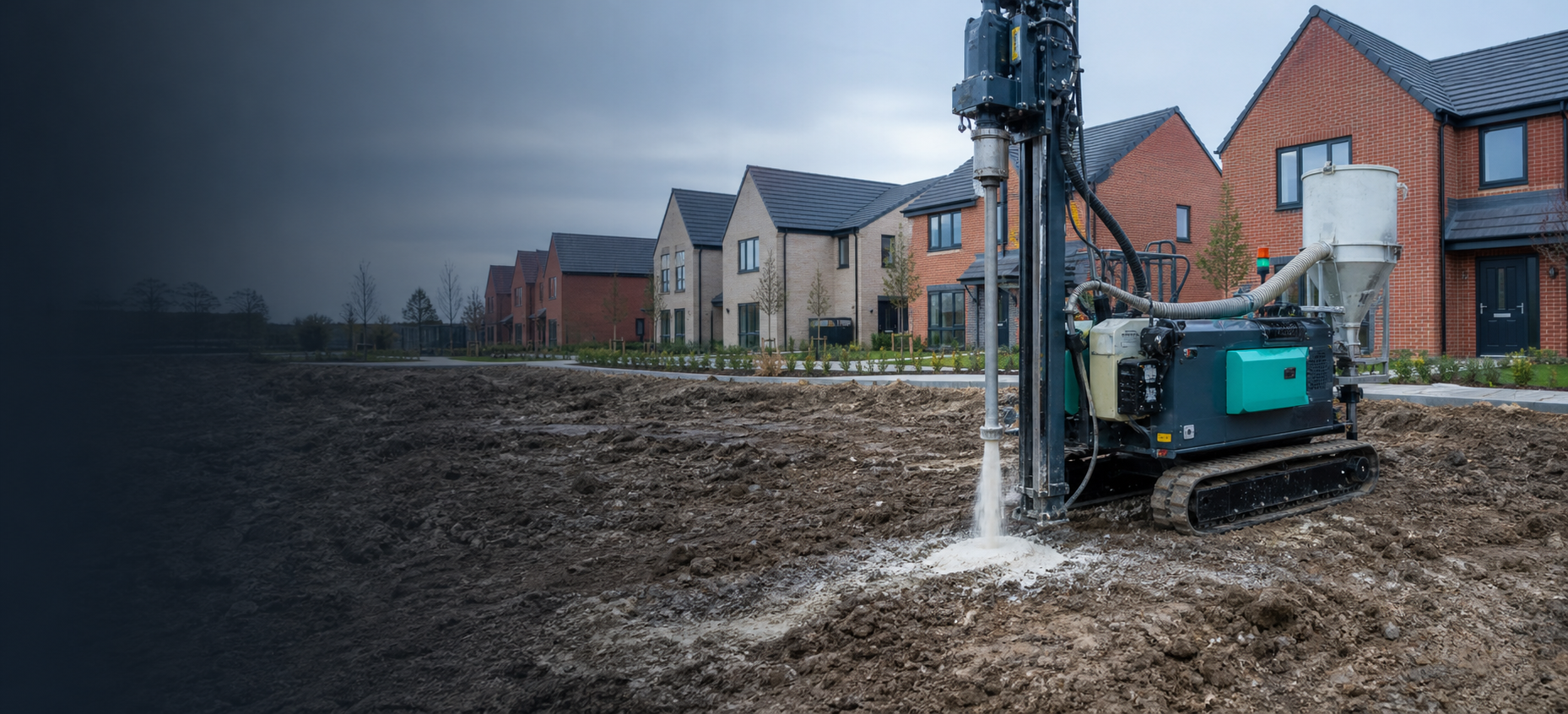
Residential to development scale
Compact treatment equipment supports access to occupied homes and finished gardens, while larger specialist machinery remains available where development access, treatment area and ground conditions justify it.
Explore ground improvement ↗A new home should not come with a garden you cannot use.
Heavy clay and construction traffic can leave new-build gardens compacted, saturated and slow to recover after rain. Hydrofence treats the affected ground in situ—giving water new pathways without defaulting to widespread excavation.

A controlled high-pressure air pulse leaves the probe at the target depth, creating a network of irregular fissures through the dense clay.
Fine mineral particles are carried into the new fissures, placing calcium throughout the treated zone rather than only at the surface.
Where soil chemistry is suitable, calcium can encourage fine clay particles to group into larger aggregates. That more open structure supports connected pore space and easier water movement.
What changes? The treatment combines physical decompaction with mineral amendment. Results depend on clay mineralogy, existing calcium levels, compaction and site drainage, which is why every garden starts with an assessment.
Our specialist equipment is substantial enough to deliver controlled pressure at depth, yet compact enough to reach most rear gardens through a normal side gate.
One professional system, designed to reach the garden, assess the problem and treat compacted clay with minimal disruption.
A more permeable soil profile. Treatment design depends on site investigation, soil conditions and drainage objectives. Hydrofence does not replace engineered drainage where it is required.
Designed around the realities of occupied new-build homes—from narrow access and finished patios to lawns that remain saturated long after rain.
Targeted probe points minimise excavation, spoil movements and reinstatement.
Treatment can be planned around the compacted horizon and local soil profile.
Suitable for lawns, planted areas and finished gardens—subject to an individual assessment.
For properties with vulnerable openings or residual flood exposure, Hydrofence also helps compare barriers, air-brick covers, pumps, valves, alarms and emergency equipment.
The language, evidence and next step adapt to the person responsible for the property or site.
Clear screening, practical surveys, garden treatment and property-level protection.
Explore home services ↗Site context, repeatable survey outputs, plot drainage treatment and aftercare support.
Explore development services ↗Property resilience, managed landscapes, monitoring plans and commercial quantities.
Start a commercial enquiry ↗A measured process, shaped around your soil, programme and site constraints.
We discuss symptoms, ground conditions, build stage and drainage history.
On-site assessment establishes compaction depth and a suitable treatment pattern.
The probe delivers controlled air and calcium sulphate at the planned locations.
We record the work completed and agree any monitoring or aftercare.
Choose the service closest to your situation to see how Hydrofence can help.
Start with the ground
Share the address, the areas affected and what happens after rain. We’ll come back to discuss whether Hydrofence is the right next step.
hello@hydrofence.co.uk ↗